

Duke researchers have uncovered the mechanism behind a decades-old mystery in biochemistry, showing how a single enzyme precisely controls one of nature's most intricate molecular rearrangements. The findings challenge long-standing models of how the reaction occurs and introduce a new concept in enzyme catalysis (the process in which enzymes speed up reactions inside living cells).
The work focuses on MoaC, an enzyme involved in producing the molybdenum cofactor (Moco). Moco is a small helper molecule required for essential metabolic enzymes to function in humans, plants, and many microorganisms. To construct the chemical core of Moco, MoaC mediates many bond-breaking and bond-forming reactions, including the relocation of a key carbon atom. Scientists have struggled for decades to explain how the process occurs.
Using a combination of biochemical experiments, mass spectrometry, and X-ray crystallography, the team, led by biochemists Ken Yokoyama, PhD, and Maria Schumacher, PhD, captured several short-lived reaction intermediates. Their findings, published in PNAS, unexpectedly revealed that MoaC temporarily forms a strong chemical attachment (called a covalent bond) with the molecule it is modifying. This bond acts as a molecular tether, allowing the enzyme to hold and guide the movement of a single carbon atom until it is placed in the correct position.
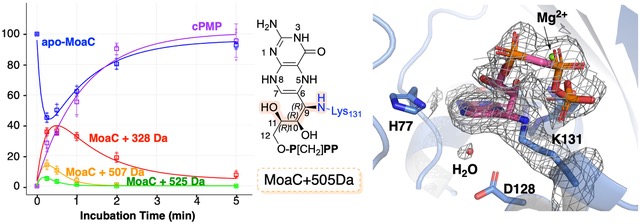
The researchers termed this newly identified mechanism "guiding covalent catalysis." Covalent catalysis is conventionally understood primarily as a way to speed up chemical reactions. But in MoaC, the covalent catalysis is used to determine where a reacting atom goes during the complex molecular rearrangement.
“We are now investigating whether guiding covalent catalysis represents a broader strategy used by enzymes that catalyze complex molecular rearrangements, including those involved in the biosynthesis of other essential cofactors,” Yokoyama said. “If so, it could reveal previously unrecognized ways that enzymes control complex chemical reactions and provide new insights into enzyme function.”
Although the study addresses fundamental enzyme biochemistry, it also has potential medical relevance, Yokoyama said. In humans, mutations affecting a related enzyme that performs the same step in Moco biosynthesis cause molybdenum cofactor deficiency, a fatal inherited disorder. In addition, many pathogenic bacteria and fungi rely on Moco and other essential cofactors for metabolism and survival. If guiding covalent catalysis is used more broadly in cofactor biosynthesis, understanding this mechanism could ultimately inform research and possibly drug development in the treatment of both inherited diseases and bacterial infections.
Funding: The National Institutes of Health.